



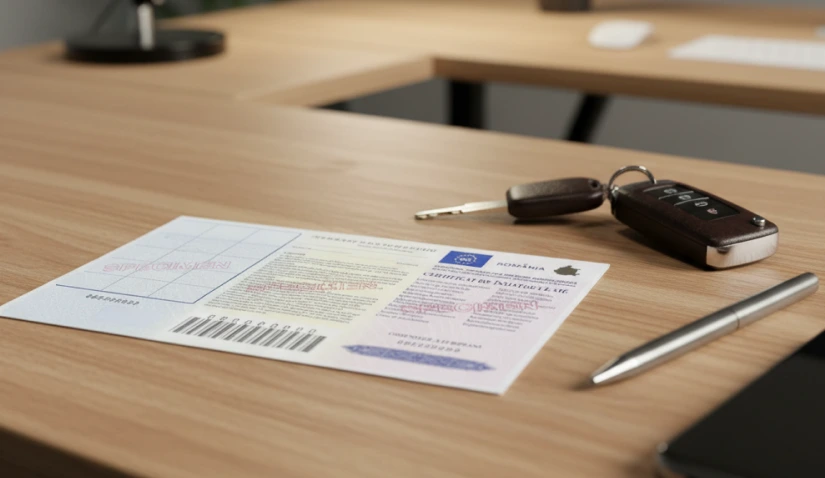
The vehicle registration certificate is the official document confirming that a vehicle is registered in the records of the Romanian road authorities. It proves the legal right to drive that vehicle on public roads.
What is the vehicle registration certificate
The vehicle registration certificate, also known as the “vehicle registration card”, is a document issued by the road authority that contains the vehicle’s technical data and information about its owner. It must be presented during a road check together with the driver’s license and the valid mandatory liability insurance policy (RCA).
Important: In Romania, traffic laws strictly require the driver to present this document in its physical, original form. Presenting a photocopy or a photo on your phone is illegal and is subject to a fine.
The document includes:
- The registration number
- The chassis number (VIN)
- The make and model of the vehicle
- The owner’s details
- The validity of the periodic technical inspection (ITP)
It is issued by the Directorate for Driving Licenses and Vehicle Registration (DRPCIV).
Fees for issuing the vehicle registration certificate
The fee for issuing the vehicle registration certificate is listed on the official page of the Directorate-General for Driving Licenses and Vehicle Registrations. The same fee applies when requesting a duplicate or replacing the document.
Payment can be made:
- Online through official payment platforms.
- At a service counter where the payment service is available.
- By bank transfer, according to the instructions of the local authority.
The fee covers the cost of printing and issuing the secured document.

Situations in which the registration certificate may be retained
The traffic police may retain the vehicle registration certificate when the vehicle does not meet the legal requirements for circulation.
Common situations in which the registration card may be retained:
- Expired technical inspection (ITP)
- Lack of a valid RCA insurance policy
- Serious technical defects identified during inspection
- Unauthorized modifications to the vehicle
- Improper or non-compliant registration plates
In these cases, a temporary replacement document is issued, and the certificate is returned after the problem is resolved and the supporting documents are presented.
Example: If the ITP (Periodic Technical Inspection) is expired, the police will withhold the certificate and issue a temporary permit without the right to drive. A crucial nuance in current legislation is that the moment your ITP expires, the vehicle’s registration is automatically suspended. Consequently, if you are pulled over in this situation, you face severe penalties: a double fine (one for the expired ITP and another for driving a vehicle with suspended registration), as well as the confiscation of your license plates. After passing the ITP inspection, the owner can claim back both the document and the license plates.
How long does it take to issue the registration certificate
Issuing the vehicle registration certificate usually takes a few working days. The document is produced centrally and delivered by post to the owner’s address.
The process generally involves:
- Submitting the request at the counter or online.
- Verification and validation of the data.
- Printing the document.
- Delivery through postal services.
The average processing time is approximately 2–5 working days, depending on the volume of requests and the locality.
What issuing a new registration certificate involves
A new vehicle registration certificate is required in cases of loss, theft, damage, or when the information recorded in the document changes.
Main steps:
- Submit an application to the vehicle registration service
- Pay the corresponding fee
- Present an identity document
- Hand over the old certificate (if available)
- Provide supporting documents (for example, a sale-purchase contract if ownership has changed)
Example: If the owner changes their permanent address, it is necessary to update the address on the registration certificate and have a new document issued. It should be specified that this obligation is critical if the new address is in a different county, a situation that automatically triggers the mandatory replacement of the license plates. If you move within the same county, keeping the current document is legally tolerated, but changing it is highly recommended to ensure the data on the certificate matches your new ID card.
Difference between the registration certificate and the vehicle identity card
There is a clear distinction between these two documents.
The vehicle registration certificate (registration card) is the circulation document required in traffic and is also used when issuing insurance policies, such as RCA insurance.
The Vehicle Identity Card (CIV) is a technical document issued by the Romanian Auto Registry. It does not need to be carried at all times, but it is mandatory for vehicle sales, deregistration, or technical modifications.
The legal status of the vehicle registration certificate in Romania
The vehicle registration certificate is the legal proof that the vehicle is registered and allowed to circulate on public roads. Its absence or retention can lead to penalties, immobilization of the vehicle, and prohibition from driving.
In summary, the registration certificate is the official document confirming the vehicle’s registration and containing both technical and ownership details. The standard issuance fee is currently 49 RON, and the certificate may be retained for irregularities such as an expired technical inspection or lack of valid insurance. Issuance usually takes a few working days, and obtaining a new certificate requires applying, paying the fee, and providing supporting documents.